

Pastry, Pleasure, and Balance
Why “Less but Better” Is a Natural Outcome of Thoughtful Design

Introduction
Pastry holds a unique place in our food culture. It was never created to meet a daily nutritional requirement, nor to function as an automatic dietary habit. Whether it is a family dessert shared at the table, an exceptional cake reserved for a special occasion, or a simple viennoiserie enjoyed in the morning, pastry has one primary purpose:
To offer a moment of pleasure.
For that pleasure to fulfill its role, it must be memorable. When a dessert is intense but fleeting, overly uniform in taste or texture, it disappears quickly from memory and invites repetition. When it is structured, balanced, and clearly defined, it satisfies more completely.
This is where pastry can remain compatible with a balanced lifestyle — not through restriction or dietary claims, but through thoughtful design.
The True Role of Pastry
Pastry is not a functional food. It is not meant to provide long-term satiety, nor to be consumed out of necessity. It is connected to pause, sharing, celebration, or simply a defined moment within the day.
When pastry is treated as such, it does not need to be repeated multiple times daily.
Problems arise when desserts lose their distinct character. When standardized, overly uniform, and consumed without attention, they shift from being a moment of pleasure to becoming a reflex.
The question is not whether pastry is “good” or “bad,” but whether it is:
Designed to be memorable — or endlessly repeatable.
Ordinary Pleasure vs. Memorable Pleasure
There is a widespread assumption that stronger sweetness and softer textures automatically create greater enjoyment. In reality, desserts that are excessively sweet and uniformly soft are often consumed quickly and forgotten just as quickly.
A uniform pleasure is a short pleasure.
When satisfaction fades rapidly, it naturally invites repetition. This repetition is rarely deliberate; it often stems from incomplete sensory fulfillment.
By contrast, memorable pleasure relies on depth rather than intensity. It engages attention. It unfolds over time. It leaves a sensory imprint that reduces the need for immediate repetition.
The Multiplicity of Flavors
One of the most effective ways to create a memorable dessert is through the combination of distinct flavor profiles.
A pastry built around a single dominant note — typically sweetness — reaches its limits quickly. To sustain interest, it must increase intensity, often by adding more sugar.
When multiple flavor dimensions are present, the experience becomes richer and more balanced:
-
A slight acidity from fruit
-
The roundness of butter
-
A subtle bitterness from chocolate
-
A measured sweetness working in harmony
When flavors are clearly identifiable, satisfaction is reached sooner.
Sugar no longer masks or compensates; it supports.
At Le Petit Paris®, recipes are formulated below the average French sweetness level, not as a marketing claim, but as a direct result of prioritizing flavor clarity over sweetness intensity.
The Multiplicity of Textures
Texture influences how a dessert is consumed just as much as flavor.
A single, soft, homogeneous texture encourages rapid eating. It requires little chewing, little pause, and offers limited sensory interruption.
When multiple textures are combined, the rhythm changes:
-
A crisp layer demands chewing
-
A soft sponge offers contrast
-
A structured cream binds elements together
-
An insert or contrasting component re-engages attention
Each change creates a subtle pause.
These pauses naturally slow down consumption. They make the portion more perceptible. The dessert becomes something to experience rather than something to finish.
Structure modifies behavior without imposing restriction.
Architecture and Experience
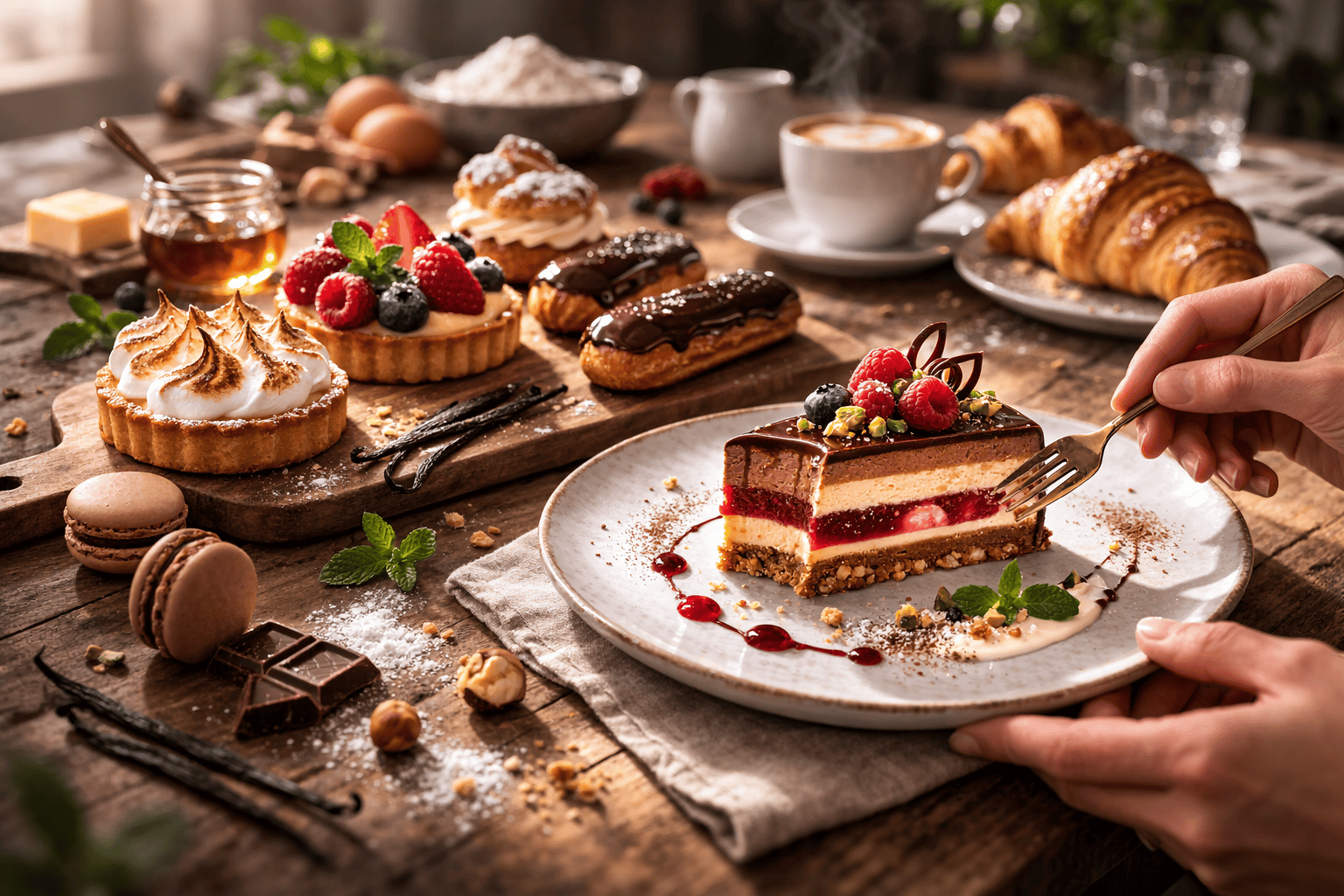
Combining different flavors and textures within a single cake does not aim to create complexity for its own sake. It aims to create a complete experience.
When each element is intentional and readable, the dessert becomes a sensory sequence. This structure encourages attentiveness. It reduces the need for large quantities because satisfaction is reached through diversity, not volume.
A well-designed pastry does not rely on intensity to be memorable.
Sugar Reduction Without “Light” Positioning
Reducing sugar in pastry is often misunderstood as an attempt to make desserts healthier or lighter. That is not the objective.
The goal is not elimination.
The goal is not substitution.
The goal is not dietary positioning.
Excessive sugar flattens flavor and masks ingredients. Adjusted sugar levels allow butter, fruit, nuts, and chocolate to express themselves more clearly.
At Le Petit Paris®, sugar reduction is a consequence of flavor-focused formulation. The dessert remains indulgent. It simply avoids unnecessary dominance.
Natural Textures and Process Clarity
Texture is inseparable from process. Natural textures result from ingredients, time, and technique. Artificially stabilized textures are often designed for transport, extended shelf life, or large-scale standardization.
In an artisanal setting working with fresh products, many stabilizing shortcuts become unnecessary.
Texture comes from craft, not correction.
This clarity enhances the sensory experience without turning pastry into a health claim.
France and the United States: Different Reference Points
Cultural context influences dessert expectations.
Traditional French pastry is generally less sweet and more structurally layered than the dominant American market, which often favors higher sweetness and softer, uniform textures.
At Le Petit Paris®, recipes are formulated below the average French sweetness level and are not adapted upward to match higher American sugar expectations.
This reflects a coherent design philosophy rather than a cultural critique.
“Less but Better” as a Natural Outcome
“Less but better” should not be understood as restriction.
When pastry is thoughtfully constructed — balanced in flavor, structured in texture, and clear in formulation — moderation becomes a natural outcome.
Consumption slows down.
Portions feel sufficient.
Immediate repetition becomes unnecessary.
The design itself guides behavior.
Conclusion
Pastry does not need health claims to justify its existence. It needs intention.
When dessert regains its role as a defined, memorable moment, it ceases to function as a repetitive habit.
Pleasure, when fully experienced, is self-limiting.
FAQ – Frequently Asked Questions
Is pastry bad for your health?
No. Pastry itself is not the issue. Problems arise when desserts are excessively sweet, uniform in texture, and consumed too frequently. A thoughtfully designed pastry meant to be enjoyed occasionally does not carry the same implications as repetitive, standardized sweets.
Does reducing sugar make pastry less enjoyable?
No. When flavors are balanced and clearly defined, reducing sugar often enhances the tasting experience. Sugar should support ingredients, not overpower them.
Why do textures matter in pastry?
Textures influence consumption speed. Structured textures encourage slower, more attentive eating, which naturally limits overconsumption.
Is a complex dessert harder to digest?
Not necessarily. When flavors and textures are clearly structured and free from unnecessary additives, the body processes the dessert in a more predictable way than highly standardized products.
Why is frequency more important than portion size?
Repeated consumption of sweet products has a greater impact than occasional enjoyment. Pastry designed as an event rather than a habit fits more easily into a balanced dietary pattern.
Is French pastry less sweet than American pastry?
In general, yes. Traditional French pastry uses lower sugar levels and more structural contrast. At Le Petit Paris®, recipes are formulated below the average French sweetness level without adapting to higher American sugar standards.
About the Author
This article was written by Stéphan Martin, French artisan baker and Ambassador of Bread, with more than 30 years of professional experience. His work focuses on artisanal pastry and breadmaking techniques, sensory balance, consumption behavior, and the relationship between food design and public health through process rather than restriction.
Key Takeaways
- Pastry is not inherently problematic.
- Repetition is a greater issue than occasional enjoyment.
- Clear flavors reduce reliance on excessive sugar.
- Structured textures slow down consumption and improve satisfaction.
- Memorable desserts discourage immediate repetition.
- Thoughtful pastry design supports moderation without dietary positioning.