

Different Types of Flour for Bread: Extraction, Protein Strength, and the Role of Long Fermentation
When discussing the different types of flour for bread, confusion often arises from international classification systems. In France, flours are labeled T45, T55, or T65. In Italy, they are known as 00 or 0. In the United States, we commonly see All-Purpose Flour, Bread Flour, and Whole Wheat Flour.
These names do not describe the same parameters. They measure different aspects of flour composition. Most importantly, they do not directly determine the final structure, volume, or physiological behavior of bread.
To properly understand flour types, four variables must always be considered together:
-
Extraction level
-
Protein percentage and protein quality
-
Hydration capacity
-
Fermentation time
Only the interaction of these four elements determines bread performance.
French Flour Types Explained: T45, T55, T65
French flour classification is based on ash content, which reflects the mineral residue remaining after incineration. This corresponds to the extraction rate, meaning how much of the wheat kernel remains after milling.
-
T45 flour → highly refined, low mineral content
-
T55 flour → standard white bread flour
-
T65 flour → slightly higher extraction
-
T80 and above → semi-whole to whole grain
When comparing the different types of flour for bread, it is essential to understand that the “T” number measures refinement, not dough strength.
A T55 flour can be weak or strong depending on wheat variety and milling blend. The T classification does not indicate:
-
Gluten strength
-
Fermentation tolerance
-
Rheological balance
-
Structural stability
It indicates only the degree of refinement.
Bread Flour vs All-Purpose Flour: The U.S. Functional Approach
In the United States, flour types are categorized primarily by intended use rather than ash content.
Common examples include:
-
All-Purpose Flour
-
Bread Flour
-
Whole Wheat Flour
For example, Sir Galahad Artisan Flour from King Arthur Baking Company contains approximately 11.7% protein, placing it in a balanced range suitable for artisan bread. It performs similarly to a well-structured French T55 or T65 flour.
Bread Flour in the U.S. typically contains 12.5–13% protein and is formulated for higher hydration and longer fermentation.
However, protein percentage alone does not define flour quality for bread.
Protein Percentage for Bread: Quantity Versus Functional Quality
When evaluating the different types of flour for bread, protein percentage is frequently misunderstood.
Wheat proteins consist mainly of:
-
Gliadins, which contribute extensibility
-
Glutenins, which contribute elasticity
When hydrated and mixed, they form the gluten network, responsible for gas retention and crumb structure.
For most artisan bread:
-
11–12% protein works effectively
-
11.5–13% supports long fermentation
But two flours at 12% protein can behave very differently depending on:
-
Glutenin quality
-
Ability to form disulfide bonds
-
Balance between tenacity and extensibility
True dough strength is determined by rheological balance, not simply protein percentage.
Real Application: Baguette, French, and Rustic French
For our Baguette, French, and Rustic French breads, we rely on Sir Galahad Artisan Flour as a structural base.
This flour offers:
-
Balanced protein level
-
Controlled extensibility
-
Sufficient strength without excessive resistance
-
Stable performance during long fermentation
However, flour alone does not determine final quality.
Long fermentation is the decisive factor.
The Central Role of Long Fermentation
When discussing the different types of flour for bread, fermentation time is often underestimated.
Long fermentation enables:
-
Progressive gluten network organization
-
Improved gas retention
-
Controlled enzymatic activity
-
Natural structural stabilization without additives
Time functions as a regulatory mechanism.
Even a high-protein bread flour will produce tight or unbalanced crumb if fermentation is rushed. Conversely, a balanced flour properly fermented can produce stable, coherent structure without excessive protein levels.
Whole Wheat Flour and Extraction: Structural Implications
For most of our other breads, we incorporate whole wheat flour in measured proportions.
Whole grain flour increases:
-
Fiber content
-
Mineral density
-
Water absorption
-
Mechanical interference with gluten formation
Without process adaptation, this can result in:
-
Reduced volume
-
Dense crumb
-
Structural instability
With long fermentation:
-
Acidification moderates enzymatic activity
-
The starch-protein matrix reorganizes gradually
-
Crumb cohesion improves
-
Hydration stabilizes
Extraction modifies composition.
Fermentation determines structure.
Comparing French Flour Types and King Arthur Flour
When comparing French flour types with King Arthur flour:
-
T55 may resemble All-Purpose in extraction but differ in strength.
-
T65 may function similarly to a balanced artisan bread flour.
-
Whole Wheat flour behaves comparably across systems in terms of absorption and fiber interference.
The difference lies in classification logic:
-
France classifies by mineral content.
-
The United States classifies by intended function.
Neither system alone predicts fermentation performance.
Common Misconceptions About Flour Types
“T45 means weak flour.”
Incorrect. It indicates refinement, not strength.
“Bread flour automatically produces better bread.”
Not without proper fermentation management.
“Higher protein guarantees better results.”
Structural balance matters more than quantity.
“Whole wheat flour is automatically more digestible.”
Digestive behavior depends on fermentation and final structure.
Structural Matrix and Physiological Perspective
Bread is a complex structural matrix, not just flour and water. It forms through:
-
Gluten network development
-
Starch gelatinization
-
Enzymatic transformation
-
Controlled hydration
Long fermentation modifies this matrix by gradually reorganizing protein interactions and enzymatic pathways. The resulting crumb structure influences mastication and enzymatic exposure.
Thus, when evaluating the different types of flour for bread, the essential question is not “Which flour is best?” but:
How will this flour behave under this specific process?
Final Perspective: Flour Is the Starting Point, Process Is the Determinant

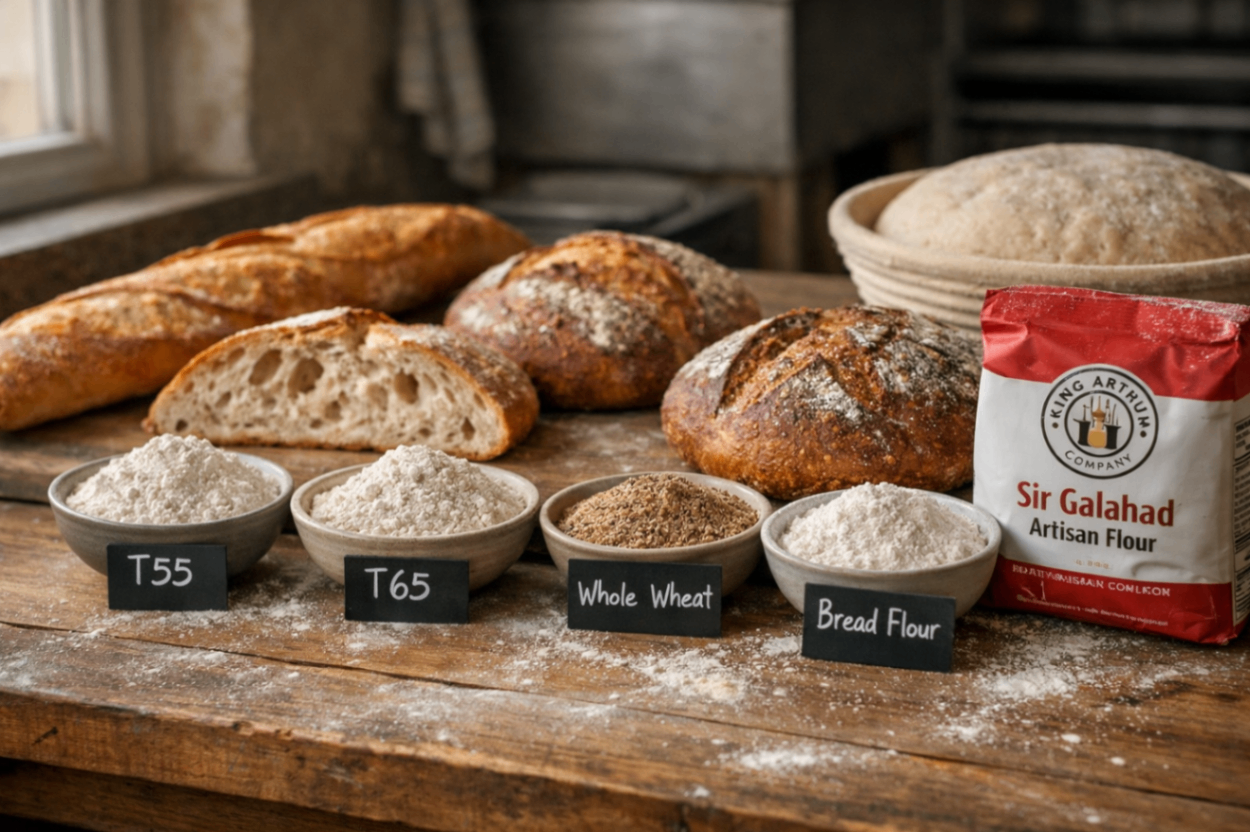
When producing Baguette, French, and Rustic French breads, we use Sir Galahad Artisan Flour as a balanced structural base and rely on long fermentation to progressively organize the gluten network, improve gas retention, and stabilize crumb structure without additives; for the majority of our other breads, we incorporate whole wheat flour to increase fiber and mineral density while carefully adjusting hydration and fermentation time to maintain structural coherence; ultimately, the different types of flour for bread do not determine quality by themselves — it is the interaction between extraction level, real protein strength, hydration, and long fermentation that transforms flour into bread that is structurally coherent, stable, and technically controlled.