
The Salt in Bread: Real Role, Baking Methods, and Health Impact
1. A persistent misconception about bread and salt
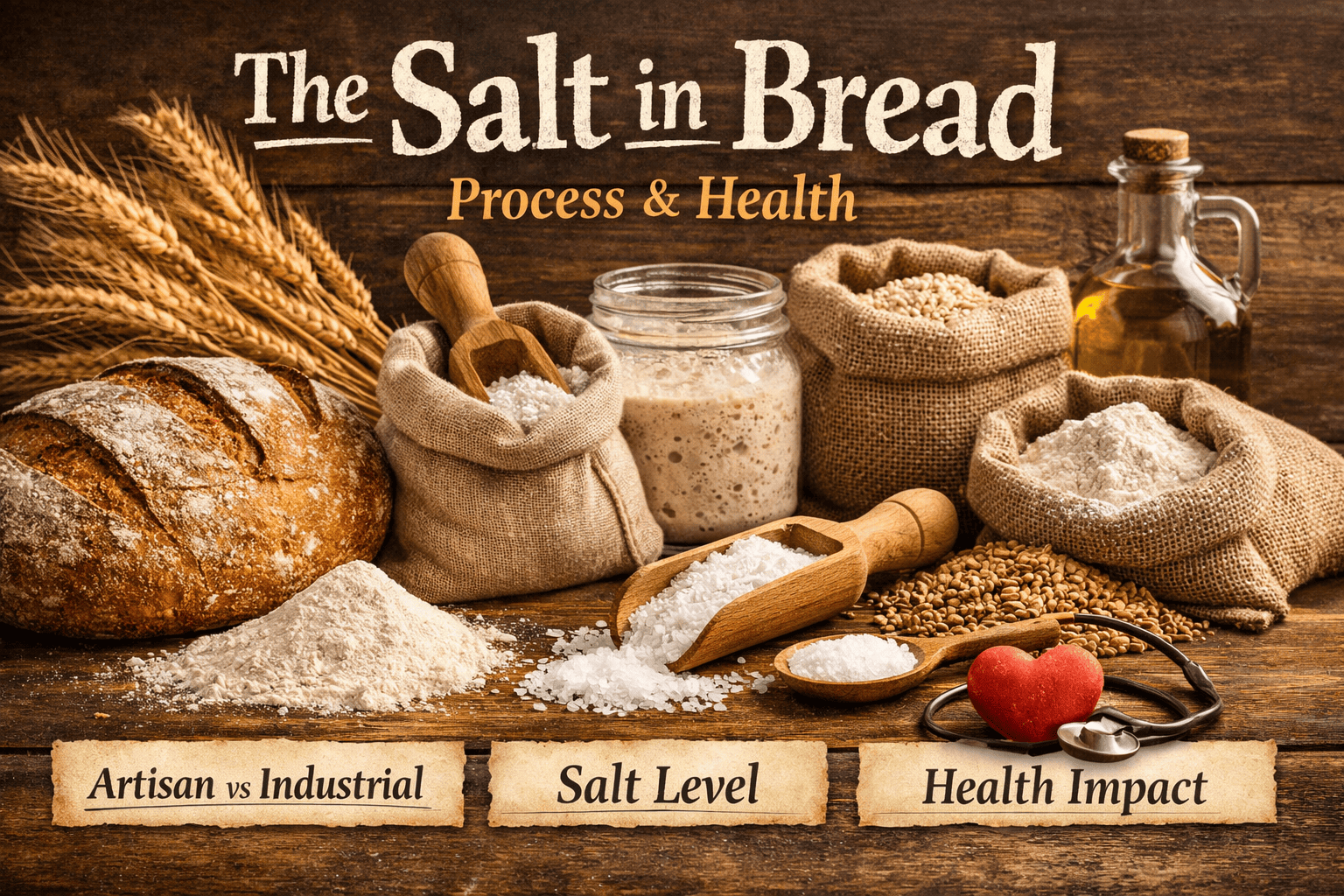
Bread is frequently described as too salty and therefore problematic from a nutritional standpoint. This perception often leads consumers to reduce or eliminate bread in an attempt to lower sodium intake. While concerns about excessive sodium consumption are legitimate from a public health perspective, this reasoning oversimplifies the issue and fails to distinguish between different types of bread and, more importantly, different methods of production.
Bread is not a uniform product. Its salt content depends directly on how it is made. Treating artisanal bread as nutritionally equivalent to industrial bread ignores the role of fermentation time, ingredient quality, and process control. The real issue is not bread itself, but specific manufacturing practices that rely heavily on salt to compensate for speed, standardization, or lack of fermentation.
2. The real role of salt in breadmaking
Salt is a technically essential ingredient in breadmaking and has been used for centuries for valid functional reasons. Its role extends far beyond simple salinity and directly affects dough behavior and final bread quality.
-
Flavor structure: salt organizes and balances taste, supporting aromatic clarity rather than acting as a simple flavoring agent.
-
Fermentation control: it regulates yeast and sourdough activity, preventing excessively fast or unstable fermentation.
-
Dough structure: salt strengthens the gluten network, improving dough cohesion and gas retention.
-
Secondary effects: it indirectly influences crust coloration and shelf stability through its effect on water activity.
These functions are legitimate. Problems arise when salt is no longer used to support a well-designed process, but instead replaces key elements such as fermentation time.
3. When salt replaces time
In short-fermentation breadmaking, aromatic development is inherently limited. Enzymes have little time to act on starches and proteins, fermentation produces gas rapidly but without complexity, and dough structure is achieved mechanically rather than biologically.
In this context, salt becomes a central corrective tool. It provides immediate flavor intensity, stabilizes the dough quickly, and standardizes the final product. Instead of supporting fermentation, salt compensates for its absence. This logic is particularly common in standardized production systems, where speed and consistency take precedence over flavor development.
The issue is not the presence of salt itself, but the role it is forced to play when time is removed from the process.
4. Industrial bread and artisanal bread: two fundamentally different logics
Industrial bread production is designed around speed, uniformity, and reproducibility. Fermentation times are short, variability must be minimized, and flavor must remain constant across large volumes. In this model, salt becomes a structural pillar of formulation. It ensures immediate and predictable taste, masks variability in raw materials, and guarantees consumer acceptance.
From a nutritional standpoint, this type of bread—widely consumed and highly standardized—contributes significantly to daily sodium intake. Salt plays a dominant role not only in structure and shelf life, but also as the primary carrier of flavor.
Artisanal bread, when properly mastered, follows a different logic. Fermentation time becomes a core ingredient. Flavor is not added but built gradually through enzymatic activity and biological maturation. Salt no longer needs to carry the sensory profile alone. It becomes a tool for balance rather than dominance, allowing flavor to emerge from the flour, the grain, and the fermentation itself.
5. Salt levels: common practices and a deliberate choice
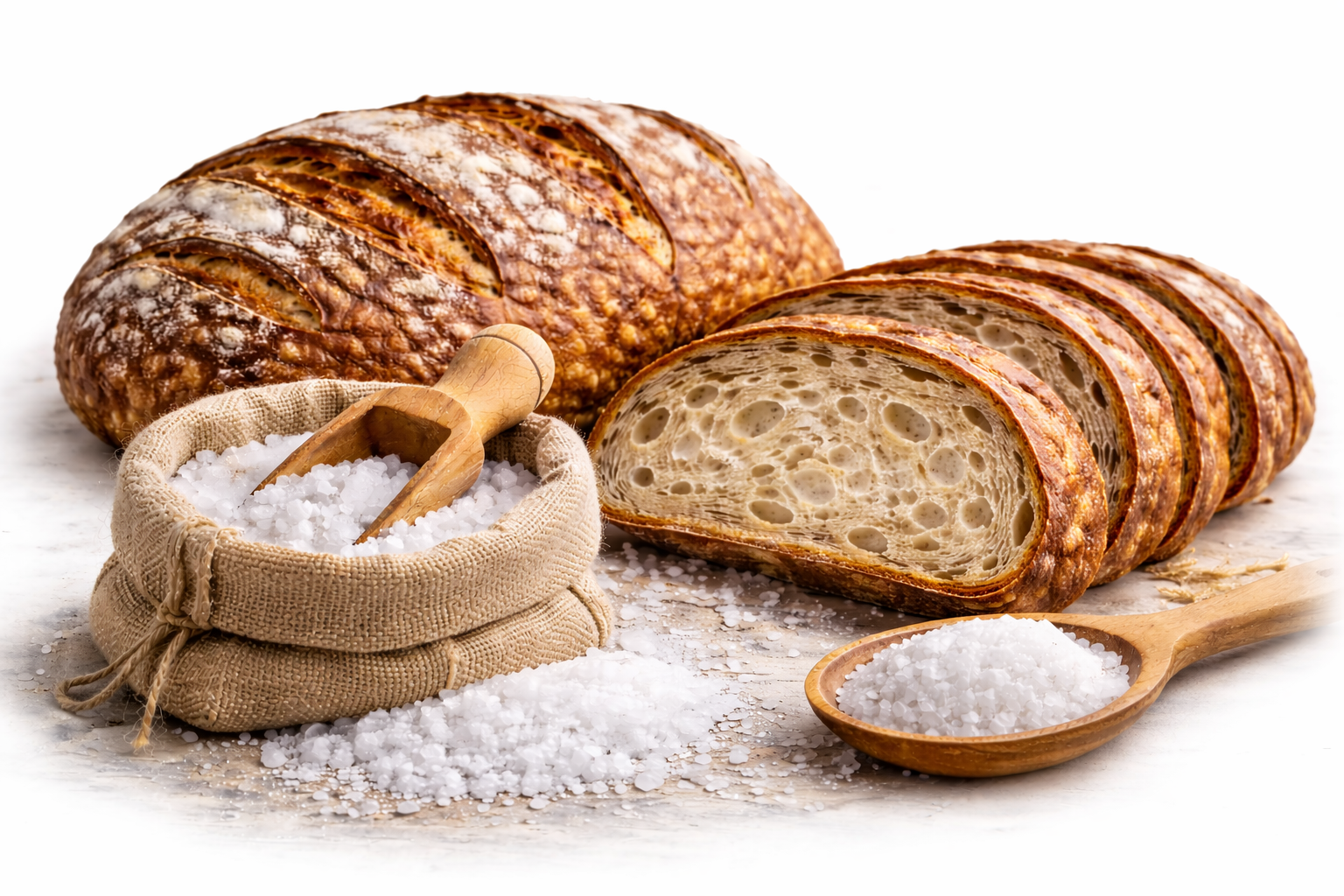
In artisanal baking, common practice typically ranges between 15 and 20 grams of salt per kilogram of flour. These levels are historically established and compatible with a wide variety of production methods, including intermediate fermentation times. However, they are not technically unavoidable when the process is designed around long fermentation.
In industrial bread, final sodium levels are generally higher and are expressed in milligrams of sodium per 100 grams of finished product. This reflects a formulation-driven approach focused on consistency and immediate taste perception.
Our choice falls outside these norms. We work at 13 grams of salt per kilogram of flour (1.3%). This level is lower than standard artisanal practice and cannot be achieved without strict control of fermentation and oxidation. It is not a universal rule, but a technical decision consistent with a specific method of breadmaking.
6. Why 13 g/kg is possible with the Respectus Panis method
The Respectus Panis method is based on respecting the biological time of dough. Long fermentation allows deeper aromatic development and progressive gluten structuring without excessive mechanical input. Oxidation is limited, preserving both flour quality and aromatic compounds.
Within this framework, salt no longer compensates for process weaknesses. At 13 g per kilogram of flour, it regulates fermentation without blocking it, supports structure without rigidifying the dough, and balances flavor without masking subtle aromas. Salt is neither removed nor minimized for ideological reasons; it is placed back into its proper functional role.
7. Sensory effects of reducing salt
Salt concentration directly shapes how bread is perceived. At higher levels, salinity dominates the palate, flattening aromatic nuance and reducing the readability of the flour’s character.
When salt is reduced within a long-fermentation process, the sensory profile shifts. Wheat flavors become clearer, cereal notes emerge, and fermentation-derived aromas gain depth. Flavor no longer depends on salinity intensity but on raw materials and time. Reducing salt does not remove taste; it relocates its source.
8. Health impact: conditions affected by salt reduction
From a public health perspective, excessive sodium intake is associated with several well-documented conditions:
-
Hypertension
-
Cardiovascular diseases
-
Stroke risk
-
Fluid retention and hydrosodium imbalance
Because bread is consumed daily, even moderate salt reduction can significantly lower overall sodium exposure without changing eating habits or reducing enjoyment. This approach is preventive rather than therapeutic, based on consistency and frequency rather than medical intervention.
9. Behavioral effects and relationship to taste
Beyond numerical intake, reducing salt alters how taste is experienced. High salinity encourages preference for intense, standardized flavors. Lower salinity, when supported by fermentation, promotes earlier sensory satiety and greater appreciation of natural aromas.
Bread is then eaten for its intrinsic flavor rather than its salt intensity. This shift is gradual but sustainable when quality remains consistent.
10. Technical responsibility and artisanal coherence
Working at 13 grams of salt per kilogram of flour is not a marketing statement. It is the consequence of a methodological choice and a refusal to use ingredients to compensate for process shortcuts. Salt is applied precisely, proportionately, and responsibly.
Baking technique directly influences nutritional outcomes. This is where well-controlled artisanal breadmaking can have a tangible and measurable impact.
Conclusion
The question of salt in bread cannot be reduced to a single number or a general nutritional warning. It must be understood through the lens of the baking process that determines salt usage, flavor perception, and health impact. When salt compensates for insufficient fermentation or speed-driven production, it becomes dominant. When fermentation, time, and process control are prioritized, salt returns to its rightful role as a balancing tool.
The choice to work at 13 grams of salt per kilogram of flour is only possible because fermentation, biological timing, and low oxidation replace salt as the main drivers of flavor. This approach simultaneously lowers sodium exposure in a daily food and restores the intrinsic taste of wheat, flour, and bread.
This philosophy guides the work of Le Petit Paris, where technical discipline is viewed as a form of nutritional responsibility. Salt is not removed, but repositioned—serving the bread rather than defining it.
FAQ – Frequently Asked Questions
Is bread bad for your health?
No. Bread itself is not the problem. Slowly fermented, additive-free bread with controlled salt levels can be part of a balanced diet.
Is salt in bread always an issue?
Not necessarily. Its impact depends on quantity and manufacturing method. Long fermentation allows lower salt levels without compromising flavor.
Is artisanal bread less salty than industrial bread?
In most cases, yes. Industrial bread often relies on higher salt levels for standardization, while artisanal bread can reduce salt through fermentation and time.
Does reducing salt make bread tasteless?
No. Proper fermentation reveals subtle flavors from flour, grain, and fermentation.
Does bread contribute significantly to daily sodium intake?
Because bread is eaten daily, reducing its salt content meaningfully lowers overall sodium exposure.
About the Author
This article was written by Stéphan Martin, French artisan baker and Ambassador of Bread, with more than 30 years of professional experience. His work focuses on long fermentation methods, additive-free breadmaking, and the relationship between artisanal techniques, sensory balance, and public health nutrition.
-
Bread is not inherently unhealthy.
-
Salt content depends on how bread is made.
-
Industrial bread generally uses higher salt levels than artisanal bread.
-
Long fermentation enables significant salt reduction without flavor loss.
-
Lower-salt artisan bread supports balance, satiety, and sensory clarity.

Leave A Comment